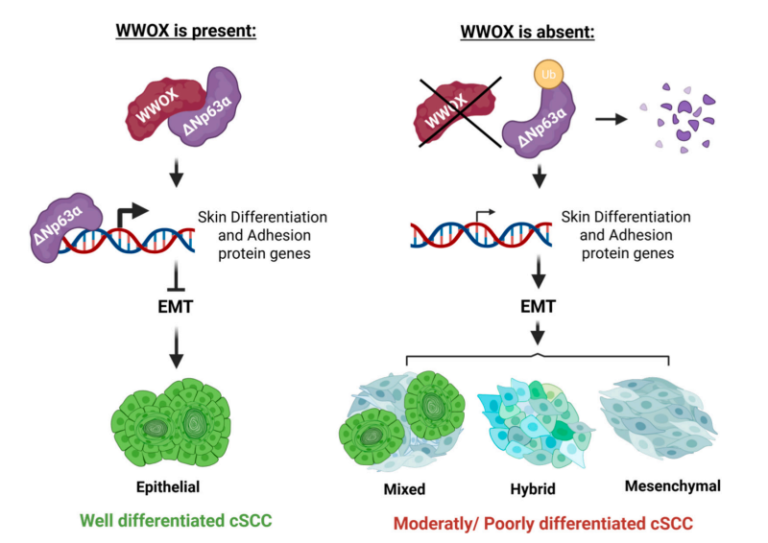
In this work, the team reveals an essential role for tumor suppressor WWOX in maintaining epidermal integrity and suppressing progression of cutaneous squamous cell carcinoma (cSCC). Using conditional mouse models, transcriptomic profiling, mechanistic studies, human keratinocyte and cSCC cell systems, and human tissue microarrays, they show that loss of WWOX promotes the development of earlier, more penetrant, and more poorly differentiated cSCC, especially in the setting of p53 deficiency. Mechanistically, it was found that WWOX helps preserve the epithelial program by supporting p63, a master regulator of epidermal identity. When WWOX is lost, p63 levels and activity decline, epithelial gene expression is compromised, and tumors acquire features of epithelial-to-mesenchymal transition (EMT) and increased plasticity. Functionally, WWOX-deficient human keratinocytes and cSCC cells become more migratory, more invasive, and more metastatic, highlighting WWOX as a critical barrier to tumor aggressiveness. In human cSCC samples, the parallel reduction of WWOX and p63 further supports the clinical relevance of this newly defined axis. Altogether, the new study identifies the WWOX–p63 axis as a fundamental mechanism that safeguards epidermal identity and restrains EMT-driven progression in cSCC.